A Proactive Junior Year Can Change Your Future: Your SAT Plan for 2026-27
Junior year is where it all happens. It is the year your plans for the future have to line up with the work you are putting in right now. And when it comes to the SAT, a junior has to be proactive, because nobody will schedule it for you. Your school may give you one free SAT on a school day, but beyond that, you have to choose your dates, register, and give yourself enough time to prepare properly.
So, dear Junior of 2026-27, here is an action plan for one of the most important academic steps you will take.
Step 1: Register for two or three SATs
One test day can go wrong for reasons that have nothing to do with what you know: a bad night's sleep, a cold, a section that rattles you. Two or three dates give you room to recover, and many colleges will look only at your best section scores. Here is every SAT date left in the 2026-27 school year, plus the dates College Board expects to offer in your senior fall.
| SAT date | Register by | Late registration and changes |
|---|---|---|
| Nov 7, 2026 | Oct 23, 2026 | Oct 27, 2026 |
| Dec 5, 2026 | Nov 20, 2026 | Nov 24, 2026 |
| March 6, 2027 | Feb 19, 2027 | Feb 23, 2027 |
| May 1, 2027 | April 16, 2027 | April 20, 2027 |
| June 5, 2027 | May 21, 2027 | May 25, 2027 |
| Anticipated 2027-28 dates (deadlines not yet posted) | ||
| Aug 28, 2027 | To be announced | |
| Sept 18, 2027 | To be announced | |
| Oct 9, 2027 | To be announced | |
| Nov 6, 2027 | To be announced | |
| Dec 4, 2027 | To be announced | |
Dates from College Board, checked October 12, 2026. Deadlines end at 11:59 p.m. Eastern. The 2027-28 dates are anticipated and may change, so confirm them before you plan around them. The highlighted rows are the three dates in the plan below. Swipe sideways on a phone to see the whole table.
Step 2: Pick dates that fit your year
Choose test dates that do not land in the middle of your busiest weeks. Look at your calendar before you register: your sport's playoff season, the school musical, AP exams (which run through the first half of May), a job with heavy hours. The 30 days before each test need room in them.
Strongly consider the summer. Without classes and homework, June and August are the easiest months to give the SAT real attention, and an August test still leaves you a score before most college deadlines.
The plan at a glance
Here is one plan that works for most juniors: a first test in March, a second in June, and a third in late August, each with 30 days of preparation in front of it.
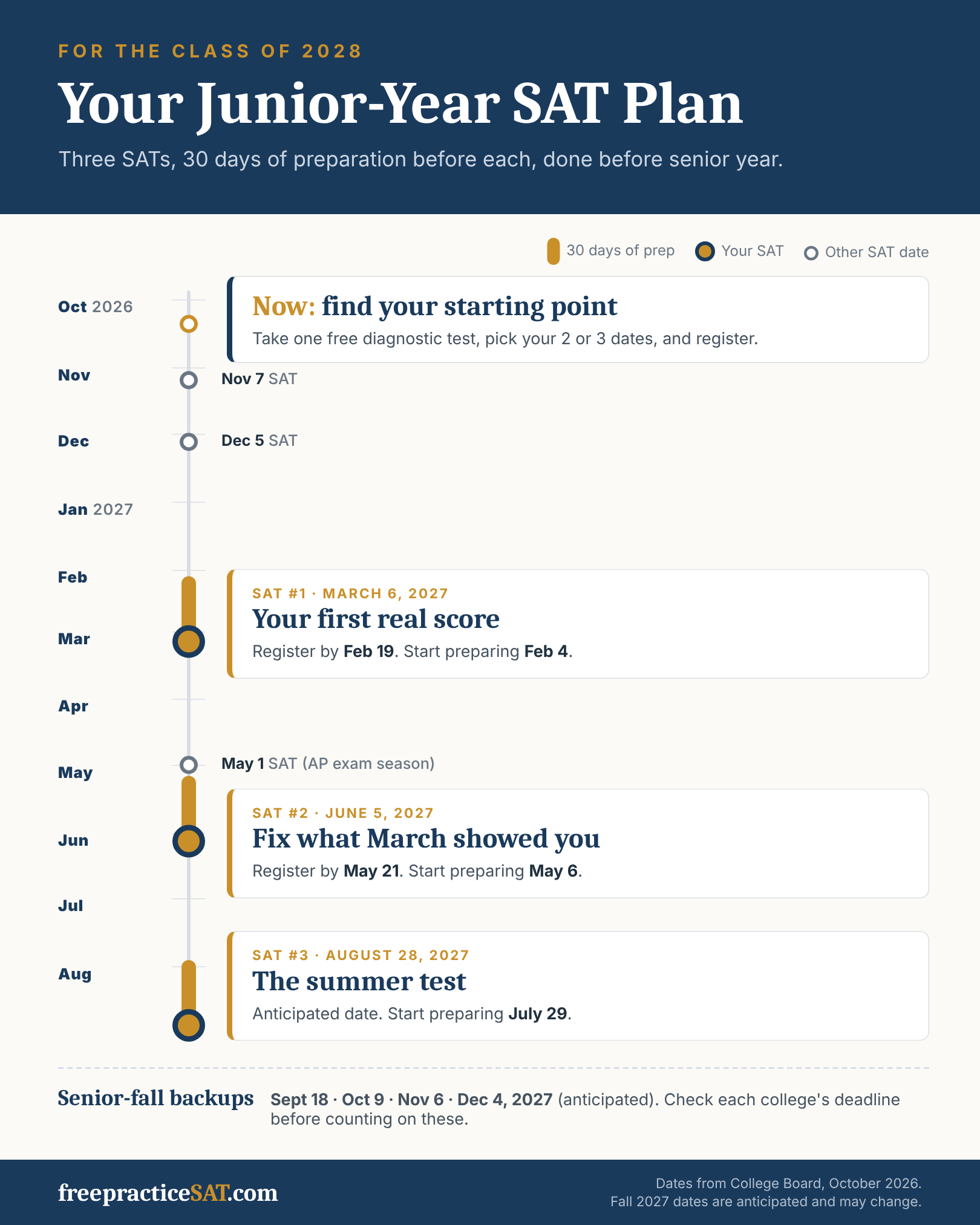
If you are ready sooner, the December 5 test is a good first attempt, and it gives you an early score to plan the rest of the year around.
Step 3: Start preparing 30 days before each test
Start your preparation at least 30 days before each test date, and settle into a rhythm you can keep. Ask yourself honestly:
- Do you work better in long sessions on the weekend?
- Or in shorter sessions of about 30 minutes on weeknights?
- Does your after-school schedule, including any job, leave you enough time to prepare?
If it does not, think seriously about pausing or cutting back your job until your SAT tests are behind you. Working too many hours can hold your score down so much that it pushes you toward a path that does not match your hopes, so make the change if you can. Of course, some students work to help their parents pay the bills. That is honorable and completely understandable, and if that is you, protect the time you do have and use it well.
Step 4: Let a website do the planning for you
Thirty days goes fast, so do not spend it guessing what to study. Use a site that tests you first and then tells you what to work on.
- For Math: freepracticeSAT.com gives you free full-length SAT math tests and names the specific mistakes behind the questions you miss, so you know exactly which skills to fix. (I built it, so I am biased.) If your basics feel shaky, start with the free Foundations course.
- For Reading and Writing: I teach math, so I do not have a Reading and Writing site of my own. The free Khan Academy Official SAT Prep course, made in partnership with College Board, covers every Reading and Writing skill, and its Course Challenge helps you decide where to start. Practice weak skills with official questions in the College Board Student Question Bank.
- For full practice tests: take at least one official test in the Bluebook app before each test day. It is the same app you will use for the real SAT.
For a side-by-side look at the free options, see The Best Free SAT Math Practice Sites in 2026, Compared.
Step 5: Take care of the student taking the test
Your score depends on more than the hours you study. While you prepare, build these seven habits. I explain each one in 7 Surprising Things That Can Boost Your Teen’s SAT Score.
- Read books. Any genre counts. Reading builds the stamina for dense passages and long word problems.
- Sleep enough. Sleep is when your brain stores what you studied. It beats a late-night cram session every time.
- Be off your phone as much as possible. Especially at meals, while you study, and in the hour before bed.
- Exercise. A walk or a pickup game sharpens your focus and lowers stress. No gym required.
- Eat healthy. Meals with protein keep your concentration steady. Sugar and energy drinks do not.
- Build real friendships. Time with friends in person is one of the best buffers against stress.
- Be bored sometimes. Unplanned downtime lets your mind wander and work things out on its own, the kind of flexible thinking the SAT rewards.
Then enjoy your senior year
When senior year starts in August 2027, you will have done everything you can to earn your best SAT score. Then you can turn your attention to enjoying your last year of high school, applying to college (maybe even through early decision, where deadlines often fall on November 1 or November 15), and writing that all-important essay. If you still want another try, the fall dates above are your backup.
Junior year is a pivotal year. It can shape the direction of your career and your life, so do not take it lightly. Be proactive, and take control of as much of your own future as you can.
Find out where your SAT math stands today. It takes one free practice test.
Take a free practice test Try the free Foundations course